



Cognitive Mapping for the Media Industry: A Methodological Approach
Amy Schmitz Weiss, Ph.D.
Professor
School of Journalism and Media Studies
College of Professional Studies and Fine Arts
San Diego State University
https://jms.sdsu.edu/people/schmitz-weiss-amy
Cláudia Silva, Ph.D.*
Senior Researcher
Interactive Technologies Institute-Laboratory of Robotics and Engineering Systems (ITI-LARSyS)
Lisbon, Portugal
Abstract
Journalism practitioners and the academy have a long tradition of studying news audiences to learn more about them and how this may improve the news practice. However, several scholars in recent years have called into question the news audience construct via the lens of the imagined audience. In this study, we explore this aspect of imagined audience further as it relates to the mental image of the audience and where cognitive mapping practices come into play. This study provides a framework to exploring cognitive mapping in more detail in the journalism practice. In sum, the main contribution of this study is a methodological model that shows how cognitive maps can be a methodology, tool, and guide to explore what news audiences are today and how that can give newsrooms and audiences insight into each other.
Keywords: news industry. cognitive maps. visual methods. mental maps. journalism practice.
*At the time of conceptualization, writing, and revision of this article, the author was an Invited Assistant Professor affiliated with the research unit ITI-LARSyS and the University of Lisbon in Portugal. She is currently a full-time researcher at the European Commission’s Joint Research Centre (JRC) in Ispra, Italy.
Introduction
Today’s news audience is complex and dynamic. Research shows that audiences obtain their news and information from multiple sources—legacy media such as newspapers and television as well as from digital spaces such as social media platforms and non-legacy media of various digital native news organizations (Newman, 2024). Furthermore, these news audiences are nuanced in terms of their news consumption behaviors and experiences that do differ by race, income, education level and age (Eddy, 2024; Newman, 2024). Generation Z, those born in the late 1990s into the 2000s, have a new set of news consumption behaviors where they are accessing news mainly from TikTok and other social media platforms than other media spaces (Eddy, 2024; Leppert & Matsa, 2024; Newman, 2024; Oliver Wyman & The News Movement, 2023; Dimock, 2019; NextGen News, n.d.). Furthermore, Generation Z is also opting out of consuming news or much of it as recent research has shown (Oliver Wyman & The News Movement, 2023; NextGen News, n.d.). News avoidance has been on the increase, identifying that news audiences are not opting in for various reasons—ranging from ideological differences, disconnection with representation and identification with the news to quality and trust concerns as well as related to the tone or subject matter of the news (Toff et. al, 2023; Newman, 2024). This creates a pivotal moment for the journalism industry in reflecting on who is the news audience today and how best to connect with them.
Considering these factors above, we see this as an opportunity to explore a novel methodological approach to understanding audiences, particularly within the scope of literature suggesting that audiences in journalism are imagined; both professional communicators (Nelson, 2021; Coddington, Lewis, Belair-Gagnon, 2021) and digital media content creators (Marwick & boyd, 2010) form mental images of their audiences, as they cannot directly see, speak to, or interact with each individual receiver.
News audiences have long been measured by clicks on a website, views from a television show, or subscriber rates for a print product. But this is only one part of the picture. The news audience is there—albeit in different ways and contexts. Recent research has identified that the way newsrooms have long considered the audience may be along the lines of an imagined audience (Nelson, 2021). The reporter or editor may perceive in their mind who they are writing for and what they may be interested in, a form of an imagined audience member. However, does this really match up? Does the imagined audience match the real audience in the community? Does the idea of what is considered news or what is newsworthy align between the imagined and real audience?
This study seeks to explore this dimension through the lens of the mind—specifically cognitive maps. Cognitive maps have rarely been used to study the imagined audience construct (Litt, 2012; Nelson, 2021; Coddington et al. 2021). As such, our study provides a methodological model upon which to build future research, with particular guidance on how and why using visual/cognitive maps may be revealing for journalists and news audiences alike.
Cognitive maps help to situate and organize one’s way of thinking on a daily basis and how we understand the world around us (see examples of cognitive maps in Silva et al., 2019). Part of these cognitive maps are the structures that are set by reality that are layered with our imagination to help create what we see as the places and spaces around us. It creates a hybrid notion of what we see around us and how we perceive what is around us. As Kitchin (1994) points out, a cognitive map is not the same as a geographical or cartographic map, despite the shared term “map.” The term "map" in this context functions as an analogue, emphasizing the cognitive representation of spatial information rather than the physical properties of a pictorial, graphic model like a cartographic map (Blaut et al., 1970). Unlike a base map of the real world, a cognitive map does not operate as a photographic or scaled replica of reality. Instead, it is an abstract, highly selective, and generalized representation that may incorporate linguistic descriptions, visual imagery from eye-level perspectives, or schematic structures. These representations often lack the precision of geographical maps; they can be incomplete, distorted, and influenced by both shared group tendencies and individual idiosyncrasies. While some elements of cognitive maps might resemble cartographic features, their diverse forms and subjective nature highlight the differences between cognitive and geographical maps.
Imagination is a key dimension of how we understand the world, being approached in the scholarship in studies about media (Orgad, 2012) as well as journalism (Nelson, 2021; Gutsche & Hess, 2018) and cultural geography (Gutsche & Hess, 2018). In this study, we are interested in exploring at a theoretical level the connections between imagination, news media, and cognitive maps. Following the seminal work of Kevin Lynch (1960), one may risk saying that cognitive maps are powerful tools that may reflect the collective imagination about space. Yi-Fu Tuan also evokes the idea of imagination when talking about mental maps. Tuan argues that “mental maps are imaginary worlds.” Tuan, a human geographer, argues that mental maps help to explain why people migrate, and goes on to say that Europeans in the nineteenth century left their homes to go to faraway places having constructed images of their future homes “based on hearsay, letters from relatives, and immigration literature” (Tuan, 1975, p. 211). Thus, they did not go on their ventures blindly. For the author, the creation of mental maps of unseen places relies on the ability to create images rather than on the ability to recall them, leading him to distinguish memory-image from imagination-image. While the latter is arbitrary, often lacking context, the former is more accurate.
So, when one considers this thought process, the mental maps we have in our minds creates an understanding of the spaces and places around us that carry emotion, experience and meaning. These are accentuated by the kinds of information and knowledge we scaffold into this process and ultimately create forms of cognitive maps that help to orient us.
These cognitive maps have been explored in other areas of the academy—such as psychology (Kitchin, 1994), geography (Matthews, 1984), mobile media (Özkul & Gauntlett, 2014) or Human-Computer Interaction (Silva et al., 2019) but few have explored this application in journalism (Gutsche, 2014). This study seeks to propose a methodological model that shows how cognitive maps can be a tool and guide to explore what are news audiences today, and how that can give newsrooms and the public insight into each other.
Literature Review
Before we jump into the specifics of this methodological approach, it is important to understand how imagined audiences and cognitive maps have formed and their application to the journalism scholarship and industry. We will organize this section in a way that it reflects the relationships among concepts depicted in Figure 1.
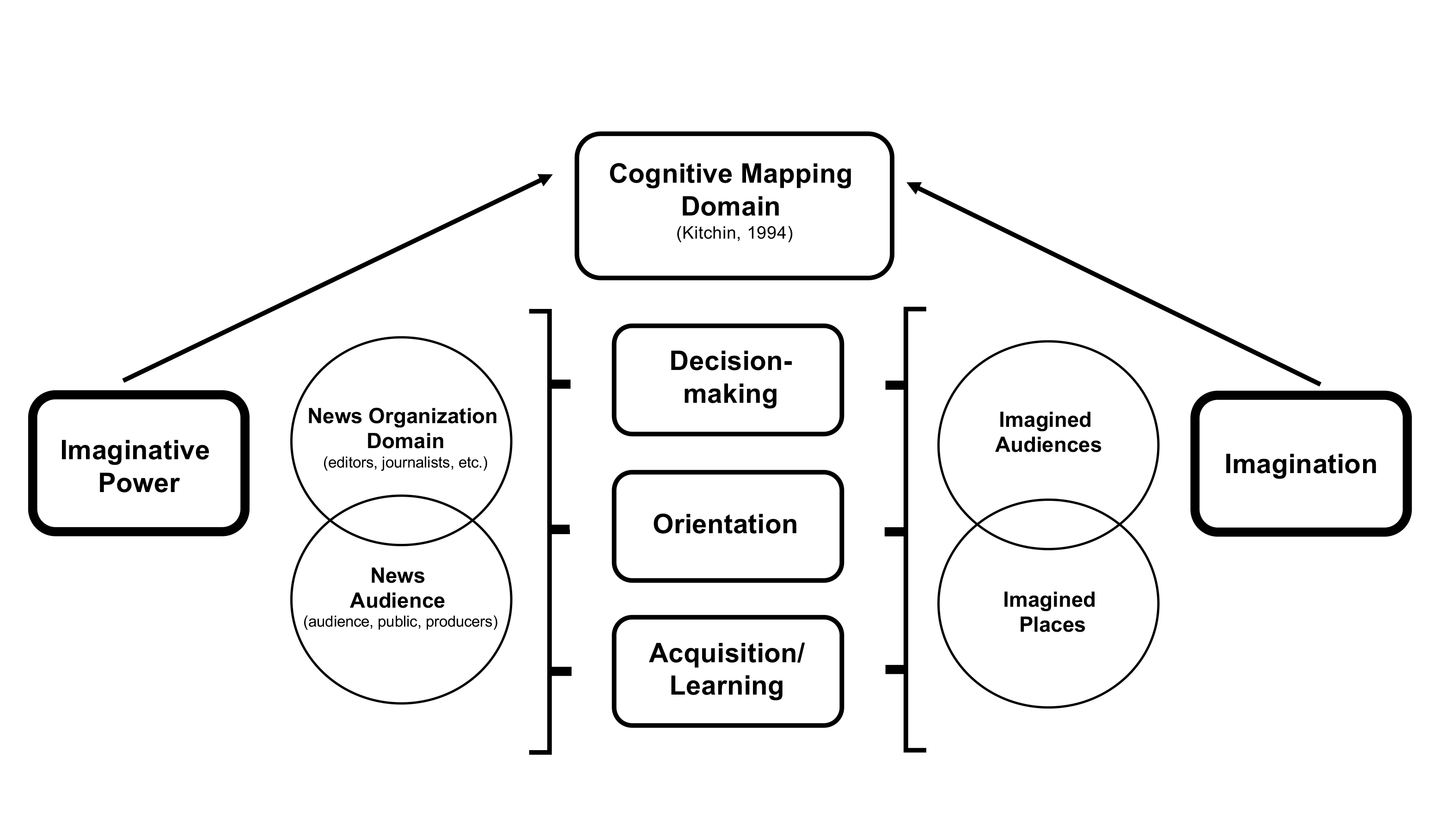
Figure 1. Cognitive Mapping Methodological Approach
Audiences
To dive into the conceptualization of the imagined audience, first it’s necessary to explain who the news audience is. Journalism research (“News Platform Fact Sheet,” 2024; Newman 2024) has identified how those consuming news from various sources - including legacy and non-legacy media dictate their role as not just consuming the news, but active members, audience members of the news. This role allows them to be interactive and engaged with the news they read, view or listen to. The frequency of accessing the news dictates their engagement and interactivity levels with the news organization through subscriptions, membership programs or other mechanisms. News organizations have come to see these forms of subscriptions as ways to identify dedicated news audiences to such news. However, this may not represent all of the news audience that can and might consume news from the news organization. What about those audiences who may live in the community but do not engage or consume news from that organization, those who may not live in the community but still care about the community, or those who might get a snippet of the news from a social media post or email newsletter or a blog post for one moment in time? These additional but sometimes invisible layers also represent the news audience and thus represent nuanced forms of the imagined audience which we discuss in this study.
Imagined Audiences
Imagined audiences are those that the journalism industry has long relied on as part of their news operations (Nelson, 2021). Imagined Audience is referred as a “mental model” (Coddington et al., 2021), as a “mental conceptualization of the people with whom [one is] communicating” (Litt 2012, p. 331), or still as “audience in the mind’s eye” (Nelson, 2021). Professional communicators (Nelson, 2021; Coddington et al., 2021) and social media content creators (Marwick & boyd, 2010) hold a mental image of their audience because they cannot see, speak, or interact with each receiver individually.
Recent studies have pursued a further understanding of how journalists conceive that mental image by using different research methods. For instance, Nelson (2021) explored this issue using ethnographic techniques, such as observations and interviews, in three news media outlets in Chicago [Chicago Tribune, City Bureau, and Hearken]. Nelson’s main findings revolve around the structural differences between legacy and non-legacy media. For traditional media, audience understanding tends to be solely metric-based, what the author calls a “reception-oriented” approach (e.g., time spent with a story, number of Tweets), whereas digital outlets seem to be committed to a “production-oriented” approach (e.g., audiences are invited to pitch stories, ask questions, create content). Another key aspect is that digital news outlets tend to see audiences as diverse groups of people, while legacy media might see the audience as a homogenous mass, which is detrimental for historically marginalized and misrepresented communities.'
Conversely, Coddington et al., (2021) conducted a statistical analysis of 544 responses from a national survey of journalists based in the United States, looking specifically at "Which sources (or type of sources) are most prevalent in shaping journalists' image of their audiences?" (p. 5) and "How do journalists' ways of knowing their audience influence their perceived evaluations of their audience's (a) rationality and (b) homophily?" (p.7). These scholars found that the most relied-upon source of audience image was interactions with sources, followed by email interactions, social media interactions, and face-to-face interactions. This result enabled Coddington and colleagues (2021) to challenge the idea of the audience being only in “the realm of mere imagination” or “sterile notions” confined to journalists’ minds (p. 14). Although Nelson (2021) also acknowledges that journalists draw not only on gut feeling but also on empirical data to form the mental image of audiences, he also deconstructs this notion by concluding: “regardless of the audience data that journalists draw on, they always have—and likely always will—rely on their intuition and gut instincts to determine whom their audiences comprise and what they want from news” (p. 145). Nelson’s bottom line argument is that “journalists’ imagined audiences stem from both the information they collect from those audiences and the assumptions they maintain about them” (p. 22).
The premise that “nobody knows anything” about audiences is a common thread in the narrative throughout Nelson’ book. Nelson argues that journalists and media producers “can never possibly know precisely who sees what they publish” (p. 14). In fact, Nelson (2021) concludes his long-term study by advocating that news scholars and publishers should embrace the concept of journalistic humility—the acceptance that journalists can never fully understand or control their audiences (p. 151).
There are several reasons why "imagined audience" is a relevant topic to be studied. Building upon Nelson (2021), this study highlights three aspects that are crucial: 1) Outreach - the ways journalists imagine audiences impact what they do to approach them; 2) Audience Engagement - the level of knowledge about the audience might influence how news organizations interact with and involve the public; and 3) News-making - journalists' imagined audiences might affect the form that news takes.
Connected to the search of understanding how imagined audiences are formed are the methods used for news organizations to gather information about the audience. Nelson (2021) states that before the digital era, journalists used to look at newspaper copies sold, and news broadcasts watched. Nowadays, audience measurement is driven by data like pageviews, which show the number of people who have clicked on a specific story, and real-time analytics platforms. These methods tell journalists how the audience interacts with news but does not offer certainty to understanding why people spend time with some stories but not others. To cover this gap, some news media outlets turn to qualitative methods such as focus groups (Nelson, 2021).
Despite these recent endeavors, the journalism industry as well as the academy is lacking methods that might capture this mental image of the audience. This study seeks to identify how scholars can operationalize an imagined audience (see Figure 1) as an empirical entity and how journalists can deploy certain methods to understand news audiences in a different way. This approach offers an opportunity to explore novel ways for professional journalists and journalism scholars to grasp how this image is formed, a research gap we intend to explore in this article.
Imagined Places
Following along this path of imagined audiences, one cannot envision imagined audiences without considering the places in which those audiences live, work, and play. In actuality, imagined places can be considered points of power dictated by journalists by the way in which the news has covered certain areas over others (Gutsche & Hess, 2018). This is what is called “imaginative power” (Gutsche & Hess, 2018) that exists to form these imagined places.
Gutsche and Hess (2018) explore the idea of imagination in journalism through the lens of imaginative power and how this power can be wielded by the media to dictate a lot of physical places. Their agency is derived from the myth and ritual placed in the news practice that extends this notion of the imaginary. Thus, this kind of approach allows the news industry to dictate the geographic locations that are real yet imaginary.
They acknowledge that the imaginative power and the imaginary are not new concepts and have explored the notion of imagined areas—but Gutsche and Hess (2018) go beyond this conceptualization, they identify that imagination’s role “extends beyond a celebration of the discursive forms through which nations and communities imagine themselves into being. Our grounding of imaginative power, rather, sits with scholars such as Ricoeur (1992) and Ritivoi (2006) who align the imaginary with doxa and myth” (p. 48).
A key point to recognize with imagination in journalism is that the news practice is housed in tradition and legacy and that journalists and editors may not necessarily realize that the places and areas that they are covering, may be remnants of the past that dictate how things have always been done within this context of news myth and ritual (Gutsche & Hess, 2018). Gutsche and Hess (2018) explain that the Oklahoma City bombings and the Columbine High School killings were not about social causes and specific places but mainly became moments of public grief. These news events displaced the geography of these horrific moments and altered it into an imagined place - “This shrinking of geographies to a single state—and a single state of mind—represents the imaginative power of the press to alter notions of space, place, location and territory when doing so benefits the dominant audience and power system” (p. 48).
In Nelson’s (2021) text of the imagined audience, he explores how the idea of imagined places has contributed to the way in which reporters at The Chicago Tribune, Hearken and City Bureau all have different interpretations of spaces and areas in Chicago that should be covered and how they are covered. These imagined places are dictated by traditional geographic and segregated markers of the city (e.g., south vs. north side) as well as the connotations of what communities exist or don’t in Chicago based on these “imagined places.” According to Nelson (2021), Hearken and City Bureau identify certain neighborhoods and areas of Chicago that are not acknowledged and haven’t been, but there can be change in how these areas are covered and can be given agency when the public is an active participant in the journalism process.
As much as the journalist and the profession have contributed to these forms of “imagined places,” the public also has notions of places. The way a person navigates their immediate surroundings and outlying areas dictates what they consider in the proximity of a place and what is not. What one recalls and chooses to recall in specific places and areas also contributes to this form of imaginary and the imagined place. So, this is a dual street in which the journalist and the public both have imagined places in mind - but the two may or may not intersect. This study intends to explore where these paths intersect and diverge.
Theoretical Framework: Cognitive Maps and Journalism
The term “cognitive maps” first appeared in the field of psychology, when the American psychologist Edward C. Tolman used it in 1948 to explain how rats, and by analogy, humans behaved in the environment (Kitchin, 1994). In general, the concept refers back to the navigational skills that enable rats in a maze to reach a food box when the familiar path has been blocked, and thus it is associated with spatial orientation.
It was not until the 1970s that the term gained recognition when adopted by developmental psychologists and later by geographers (Kitchin, 1994). Nowadays, the concept is widely used across disciplines, and as the literary scholar Marie-Laure Ryan and colleagues (2016) point out in their book “Narrating space/spatializing narrative: Where narrative theory and geography meet,” the concept of cognitive maps means different things to different people.
The discussion about cognitive maps sometimes becomes muddled when the term “mental map” is used. Although those two concepts are often used interchangeably like we do in the introduction of this article (e.g., Tuan, 1975; Matthews, 1985), “mental maps,” in turn, was a term developed in the field of geography, in which the geographer Peter Gould is a key reference (Gould, 1966; Gould & White, 1986). In an introduction to a special issue of the Journal of Cultural Geography about mental maps, the scholars Götz and Holmén (2018) refer to mental and cognitive maps as “approximate synonyms,” even though the latter, the authors go on saying, “has more neurological connotations” (p.1). Additionally, they affirm that mental map is widely studied and used in the fields of geography, behavioral science, and psychology. This confusion with different/alternative terms and meanings for cognitive maps, nevertheless, is not novel. In 1994, the human geography and software studies scholar Robert Kitchin detected what he called “surrogate terms” (p. 5) for cognitive maps, providing 19 examples from the literature. He explains the varying definitions are a result of the multidisciplinary nature of cognitive mapping. In Kitchin’s articulations, cognitive maps are not a mere set of spatial mental structures denoting relative position, “they contain attributive values and meanings” (Kitchin, 1994, p.2). On this note, the seminal book of the urban theorist Kevin Lynch, Image of the City (1960), is deemed a fundamental and pioneering piece (Götz & Holmén, 2018). Although Lynch does not use the “mental” or “cognitive” to characterize the maps/sketches in his book, the author uses the terms “mental images' to explain how dwellers read complex spatial environments like large urban cities.
Although there is no consensus or a clear distinction about those two terms, they are usually used to refer to an interest in the depiction of space in the human mind. Both cognitive and mental maps appear in the literature across different fields as pictorial ways of conveying cultural knowledge, memories, personal associations about space (Edlund, 2018).
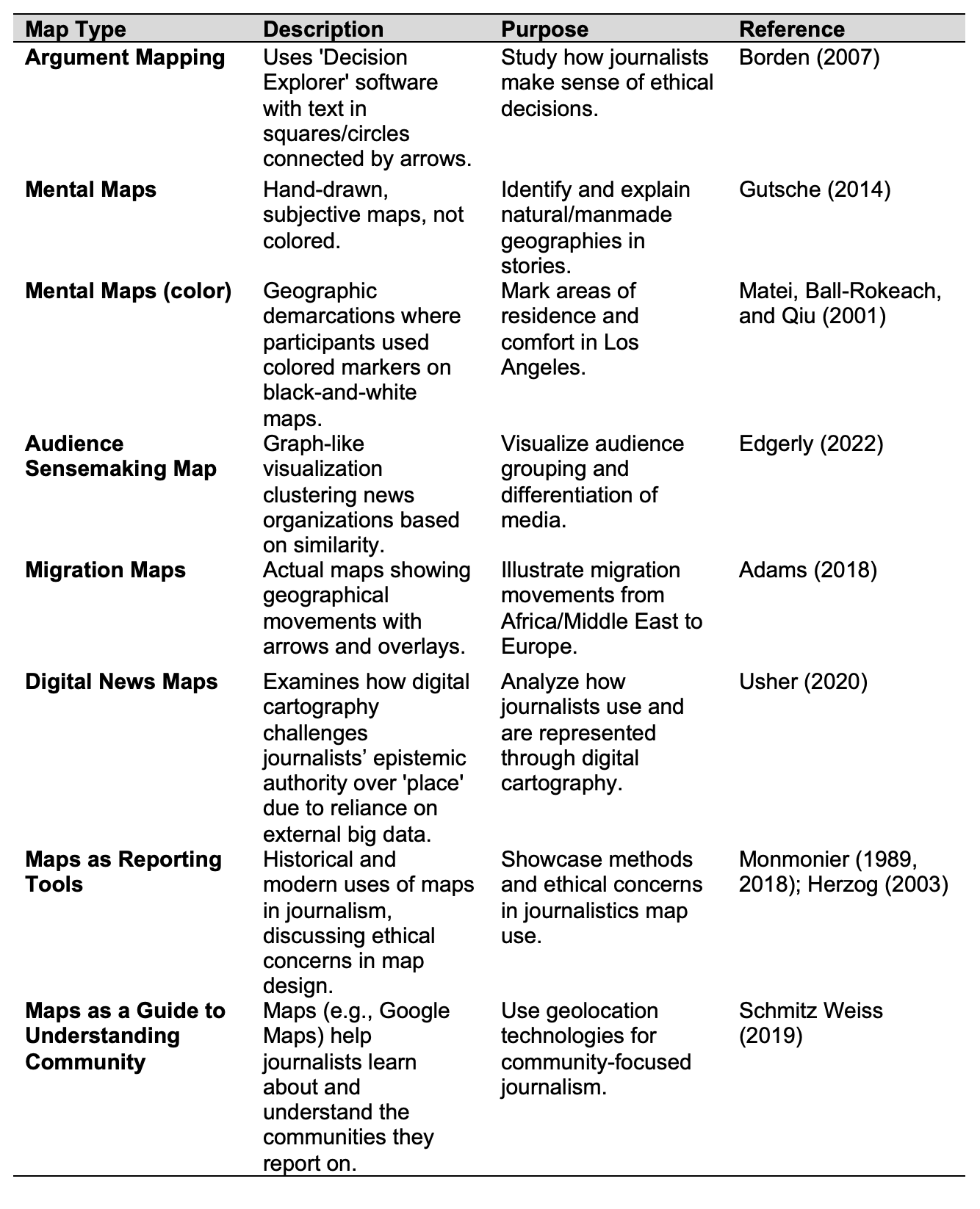
Journalism research: maps as a method. Many terms are related to mapping, which is used as a method across different disciplines. In works related to the practice of journalism, newsmaking, or communication, Borden (2007) uses “argument mapping,” Gutsche (2014) and Matei, Ball-Rokeach, and Qiu (2001) use “mental maps.” While these studies all have in common using visually distinct methods, they differ in goals and the types of maps they use. In Table 1, we summarize scholars who have applied the notions of maps in the field of journalism and communication since the 1980s. For instance, to study how journalists make sense of ethical decisions, Borden (2007) used software called “Decision Explorer” to draw maps out of focus group transcripts, generating what the author calls “argument mapping,” a cognitive mapping variant. In Borden’s work, the map is just a visualization tool to make sense of textual data, without being related to geography, space, or place. On the other hand, drawing on communication infrastructure (the communicative aspect of the urban infrastructure) to explain how social fear related to ethnicity and race is shaped concerning urban space, Matei et al. (2001) used existing black-and-white and paper-and-pencil maps to ask participants to mark their area of residence, and where they feel less or more comfortable with colored markers in Los Angeles, assigning to it a more geographical meaning. However, considering the purposes of this article, we consider this method a limited use of mental maps. We are rather interested in exploring maps sketched, hand-drawn, and from scratch, which participants have as resources in their memory or imagination. This way, even unconscious aspects might be revealed in the drawing. Considering these psychological aspects, we consider "cognitive maps" the most suitable term for our methodological proposition in this study. Aligned with the goals of this article of using cognitive mapping as a method to reveal imagined audiences, Gutsche (2014) used mental maps as a visual methodology to explore the role and influence of how journalists work and represent place in the news, a process the author calls news place-making.
He asked journalists, officials, and residents to draw maps to identify and explain natural or manmade geographies in Iowa City. His study is the closest to the definition of cognitive maps, as the scholar instructed to conceive the task as a drawing rather than an absolute representation of space with scale and proportion.
More recently, aiming to respond to the question: “How do U.S. audiences group and differentiate a selection of media organizations, and what are the larger dimensions that give structure to their sensemaking?” Edgerly (2022) used mapping as a means to understand how people make sense of the larger media landscape and how this relates to the role that news plays in their daily lives. To this end, the author applied a multidimensional scaling (MDS) technique to generate a sensemaking map—a visual depiction of how audiences perceive various media organizations in relation to each other. Drawing on the spatial metaphor of meaning (Livingstone, 1998), “organizations plotted in close proximity are similar in some meaningful way, while organizations far away indicate meaningful dissimilarity” (p. 168). Specifically, participants representing news audiences were asked to compare 13 prominent U.S. media organizations generating “an audience sensemaking map” (see Table 1) that visualizes how audiences group, differentiate and give meaning to media organizations. By applying this method, the author found that the sensemaking map suggests that two dimensions structure how U.S. audiences make sense of media organizations - political ideology (liberal or conservative) and media genre (news or entertainment).
Table 1. Approaches in journalism literature about maps
Journalism practice: map as an illustration in reporting. In addition to using maps as a research method, journalism practitioners have also used maps to illustrate news reporting. For instance, Adams (2018) offers critical guidelines for ethical visual representations of migration maps in the journalistic context. The scholar discusses how news articles on refugees, asylum seekers, and immigrants entering Europe are often illustrated with “eye-catching maps” and how these representations play a vital role within the larger body of news about migration, rendering migration visible in certain ways, directing attention toward selected aspects of migration, and reinforcing particular understandings of migrants.
For the purpose of this study, it is worth noting that Adams (2018, p. 528) states maps are “similar to other news genres in that they contribute to framing, agenda setting, and priming (Scheufele 1999; Weaver 2007; Protess & McCombs 2016).” Similarly, Usher (2020) explores the significance of maps in shaping news knowledge. According to this author, digital news cartography encompasses not only maps created by journalists but also maps utilized by them in news production, maps depicting their work, and mapping methods that foster idea generation, connections, and associations.
Conceptual Insights
Cognitive mapping. Before moving further, it’s important to discuss how cognitive mapping has evolved and its place within the context of journalism. By drawing on Roger Downs and David Stea (1973), Kitchin (1994) distinguish between “cognitive mapping,” which they describe as the mental process of thinking about a place or a route, and “cognitive maps,” which they say is “a person’s organized representation of some part of the spatial environment” (p. 1-2). Thus, cognitive mapping can be considered the act of thinking of a place or route. This act is an important element in the construction of how people view the spaces and places around them on a daily basis and also for a journalist, how they actively process the places and routes they transverse in their daily newsmaking.
Cognitive mapping approaches. Drawing on the premise that the cognitive map’s function is “to rehearse spatial behaviour in the mind” influencing behavior and decision-making, Kitchin (1994, p.6) divides research concerning spatial behavior into three main strands (decision-making, orientation and learning/acquisition). These three main strands help to orient the mind.
Decision-making. The first is decision-making in the cognitive mapping approach. The cognitive map plays a role in four questions: 1) whether to go somewhere, 2) why go there; 3) where it is the destination; and 4) how to get there (Kitchin, 1994). Kitchin’s rationale (1994) is that if one can understand where people want to go and why, then urban planners can address their needs.
Often, the news industry seeks to understand news behavior through a variety of metrics - subscriptions, clicks to a web page, and time spent on a digital app or platform. Albeit these can be helpful insights, they may not explain all aspects of news behavior and why people consume what they do. Deciding what areas of the news publication to read and how much can be further explained by mapping how one navigates through a news experience. This goes beyond eye-tracking technology (which can be inaccessible or expensive to obtain), by using a news consumer’s cognitive map to understand why the news user is interacting with certain news and not others. What decisions one takes to see what aspects of news; a crucial element is here.
In terms of newsmaking, cognitive maps could be helpful for journalists in two ways regarding decision-making: 1) to better understand their own relationships with places at the local and national level (e.g. what elements of one’s cognitive map play a role in the decision making process of the places that get news coverage?) and 2) they could draw cognitive maps of stories (places) they have covered within a certain period of time (e.g. how important is it to build a cognitive map as part of the newsmaking process?)
Conversely, it could be beneficial to engage news users with cognitive map drawing to understand their decision-making process to select the pieces of news they consume. On this note, digital outlets have an extended opportunity to grasp and reveal the hypertextual ways of how users read online news. Do news users understand how they navigate the Internet and how they are exposed to news? Is it through social networking websites mainly? A simple task would be to ask users to draw/depict the ways they navigate the news online.
Orientation. Second is orientation in the cognitive mapping approach. Orientation refers to wayfinding, the process by which a person knows where he or she is relative to something else (Kitchin, 1994).
A person may identify themselves by a specific community or neighborhood and thus may seek out information and news about such spaces and places from their local news sources.
For news organizations, knowing what a news consumer considers proximate to them in relation to their community can be an important part of deciphering how they can reach their audience. However, this can be a lot more difficult to get at without extensive research, resources, and time. Wayfinding through cognitive mapping may give insights to the news organization to know exactly some of the places and spaces that are newsworthy, as well as proximate to their audience that may allow them to have a better understanding of what news coverage can be in a given area.
Cognitive maps could be also a tool for news organizations to understand which areas are neglected or the types of stories that shape how communities imagine themselves in a specific communicative context (Matei et al., 2001). News media often influence news consumers where to go either for leisure (tourism, dining, entertainment), work or even not to go (crime, lack of resources). How do news users locate themselves in relation to news?
Learning/Acquisition. The last part to address is how the cognitive map is composed, constructed, and organized, and when changes occur in the development of this knowledge. On this note, Kitchin (1994) writes about three ways cognitive maps can be helpful: building upon Tuan (1975) and others, Kitchin explains a cognitive map as a mnemonic and metaphorical device; local/ world attitudes and perspectives; and creating and coping with imaginary worlds.
As a mnemonic and metaphorical device (Kitchin 1994), cognitive maps are a means to structure and store knowledge as well as a metaphor for non-spatial tasks. In this sense, cognitive maps are great tools to understand and reveal what news consumers learn/acquire from the news in terms of remembering events, people and things, and knowing their locations. For example, asking the news audience to review specific news content or coverage in a specific place or time and how this matches up to the mental image in their mind of such news coverage.
Furthermore, this cognitive mapping might be able to show how one learns of their areas around them and the news. It may provide insights into how a news audience gains knowledge and likewise, how a news organization can gain knowledge about the communities they serve. To evoke Ryan et al.'s words (2016, p.77) “to draw a cognitive map of social phenomena, in Jameson’s sense, is to study these phenomena not in isolation but as part of a world-spanning network. The “phenomen- ological experience” of somebody living in London might for instance be bound up to the whole colonial system of the British Empire, as this system determines the very quality of the individual’s subjective life (Jameson 1988, p. 349).”
Second, Kitchin (1994) identifies how learning is impacted by local/world attitudes and perspectives, in which cognitive maps go beyond knowledge of spatial relations to contain social and environmental meaning and knowledge. They can help to demonstrate how journalists learn and acquire information from news consumers’ world and local views and perspectives that could enhance their reporting.
And last, there’s creating and coping with imaginary worlds in the cognitive mapping sense. By evoking Tuan (1975), Kitchin (1994) presents cognitive maps as a way to act as imaginary worlds. The latter is one of the most interesting aspects for the purpose of this article, because it reveals how people conceptualize images of proximate and distant realities, and how it affects their view of the world. Kitchin writes that “we can as human beings construct mental descriptions of places we have never been to, from text such as a novel or word of mouth, such as a friend’s description of a holiday area. What we essentially do is fit them into our schema of similar events we have experienced either firsthand or secondhand through media” (p. 9). Following this notion, one may wonder how journalism may contribute to the construction of imagined places and cognitive maps could translate this into a more nuanced understanding.
Furthermore, for the news user, one can create their own imagined spaces that may or may not match up to the aims of what a local news organization may see as a news coverage area. Through the lens of cognitive mapping, being able to see the imagined news area through its development and interpretation may provide news organizations with insight into how a particular entity, group or individual may be neglected or blighted as such when news coverage doesn’t reflect nuances of such imagined spaces.
Thus, Kitchin’s spatial behavior of the three main strands (decision-making, orientation, and learning/ acquisition) helps to provide rich context to understanding cognitive mapping and how it serves multiple purposes. When applied to the journalism context, there are many pathways that news organizations can take to employ this approach through specific methods to understand their newswork as well as their news audiences (imagined, hybrid and real). These methods include a visual framework that allows one to physically draw out or sketch the spaces and places of references, a talk-aloud method on an individual level or group level, as well as conducting focus groups. These methods could all lend themselves to exploring how cognitive mapping could be employed and thus, the cognitive maps that reside within.
Operationalization of the Approach
As noted earlier, the concepts of cognitive mapping and the imagined can be better understood through a methodological model outlining their intersections, which we have developed for research application and practical use in a newsroom (see Figure 1).
As embedded in the diagram, it identifies how these three strands connect to the bigger picture of imagination, imagined audiences, and imagined places. Furthermore, they help to make clear the pathways by which news organizations and news audiences diverge and intersect with each other.
As noted in Figure 1, on the left, you have the existing structures of the news organization and news audience domain that have their unique experiences and practices within the context of journalism. Within this realm, there is an imaginative power that resides in the news organization and news audience domain that dictates the ways in which both groups envision news and places in their community.
Also noted in Figure 1, on the right, you have the imagined places and imagined audiences that intersect from the domain of imagination overall. All three feed into each other as to how the imagination can dictate how one can think of those communities, places, and spaces, as well as audiences that they create in their mind.
From there, one can see the connections between the right and left of the imagination and imaginative power that can connect to the larger cognitive mapping domain. This domain that Kitchin (1994) notes is the spatial behavior of three main strands: decision-making, orientation and learning/acquisition that make cognitive mapping occur.
Each of these three strands interweaves and interplays with the news audiences and news organizations from the left and with the imagined places and imagined audiences on the right..
Breaking these strands down and showing their interplay between these entities allows one to see clearly how there is a process and behavior that happens in cognitive mapping, which can be considered the act of thinking – on part of the journalist and the news reader for example.
This methodological model allows journalists, editors, and product managers to visualize the cognitive map process and further distill down into the decision-making, orientation, and learning/acquisition of how the news is distributed, received, and understood.
To work with this methodological approach, it consists of a news organization gathering a sample of their news audience to participate in an hour or 90-minute discussion (see Appendix for sample workplan). This session is situated with specific questions: how do you decide which news pieces to look at versus another, what kind of attachment or identity do you share with specific places or people in the community that are reflected or not in the news, and how does one structure and store knowledge about the news they receive within the imagined places and areas they already have in their cognitive map? Other questions may surface in the discussion, but this provides a starting point.
From there, a mapping exercise can be provided to allow each participant to draw out their cognitive map of where they see themselves in the community with the news organization and the journalists as well as the community and the news. This might entail the drawing of actual cityscapes, concentric circles, or other visuals. From this point, the moderator of the discussion can then reference the visuals and summarize the major points identified and conclude the session with insights on how the news organization can go forward with connecting and engaging with their news audience. After the participants have left, the news organization can analyze the discussion transcripts and the cognitive maps to plot their results to the model noted in Figure 1 to see how their audience falls into these imagined places with possible actions for the future (e.g., community events, news polls, listening events, etc.)
This model allows a newsroom to conduct in-depth discussions with their news audience to further understand their specific cognitive maps and likewise for the news audience to know the cognitive maps of the journalists in the newsroom. In a joint session where new audience members and journalists participate together (see the Appendix for sample workplan), a news audience member can understand the way they personally envision news visually through this exercise that forms from the cognitive map they provide from the discussion session with the newsroom. Likewise, the news audience can see the visual of what the journalists draw out as their cognitive maps during the discussion session. This allows both groups to ask: Do these cognitive maps intersect? Do they diverge? This can be done through focus groups, in-depth interviews, and actual diagramming of the cognitive map from the journalists and news audience.
The model also allows researchers a pathway by which to operationalize and conduct research about what is perceived and assumed and test actual spatial behavior among journalists, newsrooms, and the audience. This can be done via focus groups and in-depth interviews for example. This can help to advance the existing scholarship that has explored imagined places and imagined audiences in journalism and how they can be understood within a cognitive and spatial approach.
Figure 1 identifies how these three strands connect to the bigger picture of imagination, imagined audiences and imagined places. Furthermore, they help to make clear the pathways by which news organizations and news audiences diverge and intersect with each other.
Discussion and Conclusions
This theoretical work on cognitive maps as a methodological tool to reveal imagined audiences has several applications in the journalism field, specifically in the digital area. The present work enables us to clarify the nature of audiences (by defining and delineating the method of cognitive mapping and by positioning it relative to other means of knowing the audiences (e.g., web metrics, surveys, focus groups, social media data).
In this article, we have suggested that the concepts of imagined audiences (Litt, 2012; Marwick & boyd, 2010; Nelson, 2021; Coddington et al., 2021), imagined places (Gutsche & Hess, 2018), and imaginative power of journalism (Gutsche & Hess, 2018) are somewhat interlocked and shaped by the notion evoked by Tuan (1975), the one of an imagination-image rather than memory-image. In other words, journalists contribute to the image creation of unseen places in the audience based on imagination rather than lived experience or imaginative power as elaborated by Gutsche and Hess (2018), while the journalists themselves rely partially on assumptions/imaginations of audiences (Nelson, 2021).
This study argues that the method of cognitive maps might be helpful specifically in the scope of non-legacy media, resonating with a production-oriented approach proposed by Nelson (2021), where audiences are invited to pitch stories, ask questions, and create content, but also with the inclination to use qualitative methods such as focus groups. As part of this production-oriented approach, cognitive maps may be added as an interdisciplinary method to capture the mental image of audiences. We are not suggesting, however, that cognitive maps may constitute a stand-alone methodological metaphorical device, in Tuan’s (1975) sense, for journalism practitioners and researchers. Rather, it could be combined with other methods like informal interviews or even focus groups. Visual imagery and sketching along with these methods can help to solidify or contextualize what is being discussed and understood.
Despite the novelty of the methodological approach presented in this article, the study has certain limitations. The primary limitation is the lack of empirical research examining how journalists and audiences might find the use of cognitive mapping beneficial for understanding news. To address this, we plan to conduct focus groups or co-design workshops with journalism practitioners and audiences to gain deeper insight into the method's practical applicability. This study provides a roadmap to using this method. As this study doesn’t currently have empirical results, future research would benefit from implementing this approach. Future studies could explore this in a focus group format between the news audience and journalists, and in-depth interviews with news audience members and journalists. Practitioners could also implement these same methods in their newsroom by hosting focus groups or conducting in-depth interviews with news audience members.
This approach of cognitive mapping can be a starting point for a news organization to examine their overall organization and for the academy to use it as a tool to methodologically employ to dive into news audience and journalism practitioner perceptions. Future researchers could deploy this approach to an actual news organization (perhaps a digital-native organization) to see how the imagined audience matches up to the real audience. Only through actual case studies can one see the nuances of this approach that will be custom and personal to each news community and news organization. Cognitive mapping is an activity that can provide rich information and context to those who employ it appropriately and thoughtfully.
Drawing on the premise that the cognitive map’s function is “to rehearse spatial behavior in the mind” influencing behavior and decision-making, Kitchin (1994) divides research concerning spatial behavior into three main strands: Decision-making, Orientation, Learning/Acquisition. In building on his work, we have contended including cognitive maps to expose the relevance of places in newsmaking as well as news behavior to acknowledge the relevance of imagination and mental imagery, emphasizing how some places are neglected and how it impacts the urban communication infrastructure of, to borrow Matei and colleagues’ terms (2001). Applying these three strands, cognitive maps can contribute to engaging marginalized and vulnerable communities, which is another way digital outlets may further connect with their production-oriented approach (Nelson, 2021). Past research in the social work field has provided evidence that arts-based methods, such as hand drawing, are quite efficient for engaging marginalized communities with research (Jackson Foster et al., 2016). This may be also beneficial for community engagement in journalism.
As detailed in the Appendix with sample workflow, a news organization can engage in this cognitive mapping approach by having both the journalists and community together in the same room addressing the same questions and sketching their answers. For example, a digital native local news organization that is new to the community could engage in this approach to better understand how they can know their news audiences and in turn for the community to engage with the news organization in this exercise. It helps to establish commitment and continued relationship building. After going through the cognitive mapping exercise, the news organization can analyze the results of the sketches and provide a visual summary in conjunction with the model in Figure 1 to those who attended the cognitive mapping session and present it to a wider community through short-form videos featured on social media and their news website. They can follow up with a survey or inquiry form to gather more information from the community on the visual summary and ways that they can remain engaged and build the relationship - through forms like SMS messaging, in-person events, online meetings and so forth. They can create an action plan for moving forward that allows the news organization and the news audience to connect through this cognitive mapping approach. This can lead to new areas of news coverage, new methods to connect with the audience, and how the storytelling could be done differently. This approach can also be adapted to other forms of news organizations such as broadcast stations, legacy media operations, nonprofit news organizations and so forth.
The components of the cognitive mapping approach of decision-making, orientation, and learning/acquisition can be readily applied to the existing workflow of a news organization’s community-building and audience engagement efforts. By creating quarterly meetings with the community to delve into the imagination of the news audience and their journalists through cognitive mapping exercises allows for a reality- and accountability check on how the news organization is connecting with and being of the community they aim to serve.
As noted in the introduction, the news audience of today is more fluid and dynamic and being able to capture who they are and where they are is crucial for a news organization. As GenZ and news avoiders chart new pathways to news consumption or not at all (Oliver Wyman & The News Movement, 2023; NextGen News, n.d.), the cognitive maps approach can provide a unique process to gain traction with these audiences and where the imagined audiences reside in these circumstances. It may provide insight to news organizations on how to get news avoiders to become news consumers and how GenZ consumers can frequent news more and engage more with the news. Furthermore, this approach can help connect the news organization in an engaged dialog with marginalized and vulnerable communities. This form of visual communication of the cognitive mapping can provide another way for the news organization to connect and build a relationship with communities that have been invisible based on past beliefs of a homogenous news audience.
Journalism practitioners and researchers should consider and expect the potential benefits of a cognitive map as a method in two main ways: 1) it reflects what is important to an individual or a community as well as the potential to reveal collective values, perceptions, and patterns like potential neglected areas or communities, that otherwise would be harder to unveil through conventional methods such as webmetrics; and 2) it offers a visual platform from which communication and stories could be sparked.
As the journalism industry continues to face several challenges ranging from its business model to its credibility and trustworthiness with the audiences it aims to serve, new approaches that examine newswork may help. This study aims to provide an innovative and pioneering approach that can be employed by product managers in a newsroom that can be done in a simple setting without much technological resources and can provide significant returns.
References
Adams, P. (2018). Migration maps with the news. Journalism Studies, 19(4), 527-547, DOI: 10.1080/1461670X.2017.1375387
Blaut, J.M., McCleary, G.F. & Blaut, A.S. (1970). Environmental mapping in young children. Environment and Behavior, 2, 335–349.
Borden, S. L. (2007). Mapping ethical arguments in journalism: An exploratory study. Mass Communication & Society, 10(3), 275-297. https://doi.org/10.1080/15205430701407132
Coddington, M., Lewis, S. C., & Belair-Gagnon, V. (2021). The imagined audience for news: Where does a journalist’s perception of the audience come from? Journalism Studies, 22(8), 1028-1046. https://doi.org/10.1080/1461670X.2021.1914709
Dimock, M. (2019, January 17). Defining generations: Where Millennials end and Generation Z begins. Pew Research Center. Retrieved from: https://www.pewresearch.org/short-reads/2019/01/17/where-millennials-end-and-generation-z-begins/
Downs, R. M., & Stea, D. (1973). Cognitive maps and spatial behavior: Process and products. In R. M. Downs & D. Stea (Eds.), Image and environment (pp. 8-26). Chicago, IL: Aldine.
Eddy, K. (2024, December 20). 8 facts about Americans and TikTok. Pew Research Center. Retrieved from https://www.pewresearch.org/short-reads/2024/12/20/8-facts-about-americans-and-tiktok/
Edgerly, S. (2022). Audience sensemaking: A mapping approach. Digital Journalism, 10(1), 165-187, DOI: 10.1080/21670811.2021.1931388
Edlund, L. E. (2018). Some reflections on mental maps. Journal of Cultural Geography, 35(2), 274-285. https://doi.org/10.1080/08873631.2017.1362934
Götz, N., & Holmén, J. (2018). Introduction to the theme issue: Mental maps: Geographical and historical perspectives. Journal of Cultural Geography, 35(2), 157-161. https://doi.org/10.1080/08873631.2018.1426953
Gould, P., & White, R. (1986). Mental maps (2nd ed.). London, UK: Routledge.
Gould, P. R. (1966). On mental maps. Ann Arbor, MI: Michigan Inter-University Community of Mathematical Geographers.
Gutsche, R. E., Jr. (2014). News place-making: Applying ‘mental mapping’ to explore the journalistic interpretive community. Visual Communication, 13(4), 487-510. https://doi.org/10.1177/1470357214541754
Gutsche, R. E., & Hess, K. (2018). Geographies of journalism: The imaginative power of place in making digital news. New York, NY: Routledge. https://doi.org/10.4324/9781315148946
Herzog, D. (2003). Mapping the news, Case studies in GIS and journalism. Redlands: Esri Press.
Jackson Foster, L. J., Deafenbaugh, L., & Miller, E. (2016). Group metaphor map making: Application to integrated arts-based focus groups. Qualitative Social Work, 17(2), 305-322. https://doi.org/10.1177/1473325016667475
Jameson, F. (1988). Cognitive mapping. Marxism and the Interpretation of Culture, 348. Illinois: University of Illinois Press.
Kitchin, R. M. (1994). Cognitive maps: What are they and why study them? Journal of Environmental Psychology, 14(1), 1-19. https://doi.org/10.1016/S0272-4944(05)80194-X
Litt, E. (2012). Knock, knock. Who's there? The imagined audience. Journal of Broadcasting & Electronic Media, 56(3), 330-345. https://doi.org/10.1080/08838151.2012.705195
Livingstone, S.M. (1998). Making sense of television: The psychology of audience interpretation. NY: Routledge.
Lynch, K. (1960). The image of the city. Cambridge, MA: MIT Press.
Leppert, R. & Matsa, K., 2024. More Americans – especially young adults – are regularly getting news on TikTok, Pew Research Center. United States of America. Retrieved from https://coilink.org/20.500.12592/5eer02k on 25 Mar 2025.
Marwick, A. E., & boyd, d. (2010). I tweet honestly, I tweet passionately: Twitter users, context collapse, and the imagined audience. New Media & Society, 13(1), 114-133. https://doi.org/10.1177/1461444810365313
Matei, S., Ball-Rokeach, S. J., & Qiu, J. L. (2001). Fear and misperception of Los Angeles urban space: A spatial-statistical study of communication-shaped mental maps. Communication Research, 28(4), 429-463. https://doi.org/10.1177/009365001028004004
Matthews, M. H. (1984). Cognitive mapping abilities of young boys and girls. Geography, 327-336. http://www.jstor.org/stable/40570882
Matthews, M. H. (1985). Young children's representations of the environment: A comparison of techniques. Journal of Environmental Psychology, 5(3), 261-278. https://doi.org/10.1016/S0272-4944(85)80026-8
Monmonier, M. (1989). Maps with the news. Chicago: University of Chicago Press.
Monmonier, M. (2018). How to lie with maps. Chicago: University of Chicago Press.
Nelson, J. L. (2021). Imagined audiences: How journalists perceive and pursue the public. UK: Oxford University Press.
Newman, N. (2024). Reuters Institute digital news report 2024. Reuters Institute for the Study of Journalism. Retrieved from https://reutersinstitute.politics.ox.ac.uk/digital-news-report/2024/dnr-executive-summary
News Platform Fact Sheet. (2024). Pew Research Center. Retrieved from https://www.pewresearch.org/journalism/fact-sheet/news-platform-fact-sheet/
NextGen News. (n.d.). NextGen News report. Retrieved March 25, 2025, from https://www.next-gen-news.com/
Oliver Wyman & The News Movement. (2023). A-Gen-Z report. Oliver Wyman. Retrieved March 25, 2025, from https://www.oliverwymanforum.com/global-consumer-sentiment/a-gen-z.html
Orgad, S. (2012). Media representation and the global imagination. Cambridge, MA: Polity.
Özkul, D., & Gauntlett, D. (2014). Locative media in the city: Drawing maps and telling stories. In Farman, Jason (Ed.). The mobile story: Narrative practices with locative technologies (pp.113-127). New York: Routledge.
Ricoeur, P. (1992). Oneself as Another. Trans. K. Blamey. Chicago: The University of Chicago Press.
Ritivoi, A. D. (2006). Paul Ricoeur: Tradition and innovation in rhetorical theory. Carbondale, IL: Southern Illinois University Press.
Ryan, M. L., Foote, K., & Azaryahu, M. (2016). Narrating space/spatializing narrative: Where narrative theory and geography meet. Ohio: The Ohio State University Press.
Schmitz Weiss, A. (2019). Journalists and their perceptions of location: Making meaning in the community. Journalism Studies, 21(3), 352–369. https://doi.org/10.1080/1461670X.2019.1664315
Silva, C., Prandi, C., Ferreira, M., Nisi, V., & Nunes, N. J. (2019, June). Towards Locative Systems for, and by, Children: A Cognitive Map Study of Children's Perceptions and Design Suggestions. In Proceedings of the 2019 Conference on Creativity and Cognition (pp. 382-395). https://doi.org/10.1145/3325480.332656
Toff, B., Palmer, R., & Nielsen, R. K. (2023). Avoiding the news: Reluctant audiences for journalism. Columbia University Press. https://doi.org/10.7312/toff20518-012
Tuan, Y. F. (1975). Images and mental maps. Annals of the Association of American Geographers, 65(2), 205-212.
Usher, N. (2019). Putting “place” in the center of journalism research: A way forward to understand challenges to trust and knowledge in news. Journalism & Communication Monographs, 21(2), 84-146. https://doi.org/10.1177/1522637919848362
Usher, N. (2020). News cartography and epistemic authority in the era of big data: Journalists as map-makers, map-users, and map-subjects. New Media & Society, 22(2), 247-263., https://doi.org/10.1177/14614448198569
Appendix A
Sample 90-minute discussion workplan with news audience and journalists
Initial News Experience (25 minutes)
1. Provide an ice breaker and introduction of the session
2. Dive into their news experience as a group and individually with these sample questions:
a. Where do you look for news?
b. How do you decide which news pieces to look at versus another?
c. What kind of attachment or identity do you share with specific places or people in the community that are reflected in the news?
d. What kind of attachment or identity do you share with specific places or people in the community that are not reflected in the news?
e. How do you recall the news you have about your community -give one example.
Break- a small break before jumping into the next section (10 minutes)
Cognitive Mapping Experience – 25 minutes
Provide each participant (journalists and news audience members) with a large blank sheet of paper (e.g., US Tabloid or A3 in Europe – 11x17 inch paper) and pencils, including colored ones. Have them draw out on the map where they see themselves in the community and where the news organization is and the news that they consume. Allow free hand draw and creativity here, reminding participants that they can resort to emotions, memories, and linguistic features like writing. This might entail the drawing of actual cityscapes, concentric circles, or other visuals, too.
Reviewing Cognitive Maps – 20 minutes
From this point, the moderator of the discussion can then reference the maps and summarize the major points identified from all the participants (journalists and news audience members) and ask the participants:
a. Tell us about your map—what’s happening in it, and why you placed things the way you did.
b. What did you notice on other’s maps from your own?
c. What differences or similarities did you see?
d. How far or close is the community, news organization and you?
Conclusion – 10 minutes
Conclude the session with insights on how the news organization can go forward with connecting and engaging with their news audience from the parallels and differences drawn in the cognitive maps.
Post-Discussion:
After the session is over, the news organization can analyze the discussion transcripts and the cognitive maps to plot their results to the model noted above in Figure 1 to see how their audience intersects with these imagined places with possible actions for the future (e.g. community events, news polls, listening events, SMS messaging efforts, etc.).